
Unearthing Joy: How Metal Detecting Saved My Sanity As A Work-from-Home Parent
It started with a simple need to escape my home office. After eight hours of Zoom calls from my dining room table, the walls of my house felt like they were closing in.
As a work-from-home parent juggling client deadlines and my kids’ constant needs, I was drowning in a sea of responsibilities with no shoreline in sight.
The contemporary landscape of remote work presents unique challenges for work-at-home parents seeking balance between professional obligations and family engagement. The perpetual oscillation between career responsibilities, household management, and parental duties often relegates personal fulfillment to a subordinate position.
That’s when I stumbled upon an unlikely lifeline. Metal detecting emerges as a multifaceted recreational pursuit that offers a sophisticated solution to these modern challenges.
My Unexpected Metal Detecting Journey from Burnout to Buried Treasure
“Dad, you’re always working!” my 8-year-old son complained one Friday afternoon.
The guilt hit me like a ton of bricks. He was right. Even when I wasn’t officially “working,” my mind was occupied with emails I needed to send or projects I needed to finish.
That weekend, while scrolling through social media looking for family activity ideas, I spotted a post about a family who had taken up metal detecting. Something about the simplicity of the hobby called to me. Within days, I had ordered an entry-level detector for $150.
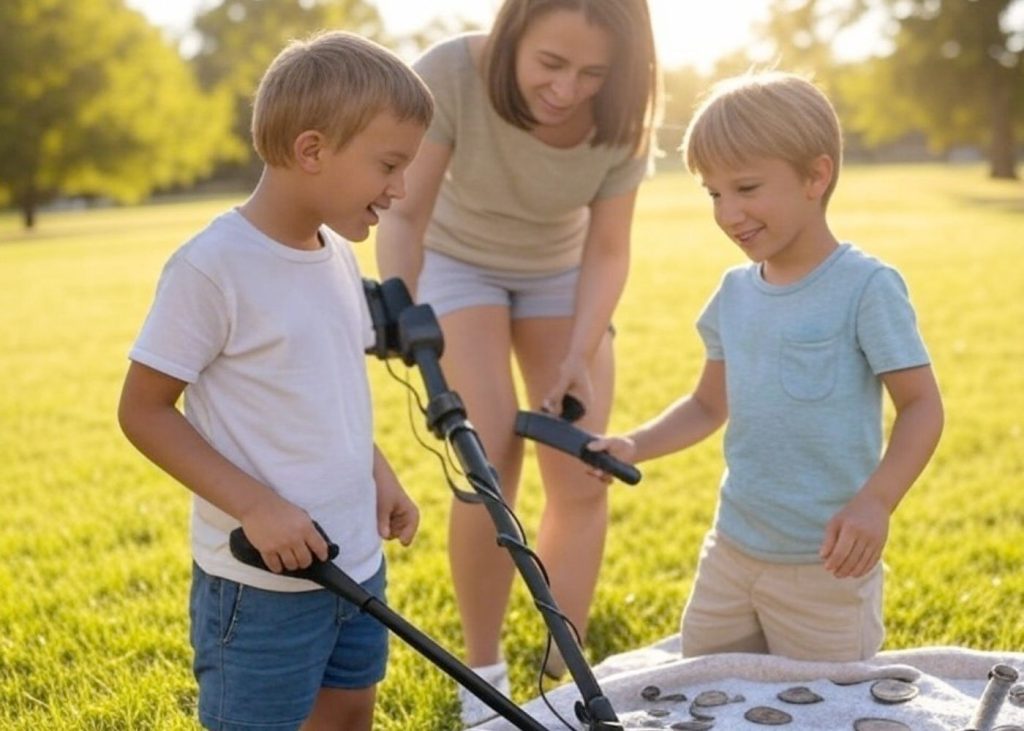
Our first outing was to a local beach. My expectations were low—maybe we’d find some bottle caps or lost change. But watching my children’s faces light up with each “beep” transformed something I’d viewed as merely a potential diversion into pure magic.

The Physical Revival of Walking Away from Screens and Into the Sunshine
Having spent the better part of two years hunched over my laptop, my body had forgotten what movement felt like.
My shoulders carried constant tension, and the headaches from screen time had become my unwelcome daily companion. These are what experts call the “physiological deficits” of remote work—and they require intentional countermeasures.
Our weekend metal detecting adventures changed that. Suddenly, I was walking for hours without even noticing the time passing. The gentle sweep of the detector became a kind of meditation in motion. One Saturday, my fitness tracker buzzed with congratulations—I’d walked over 15,000 steps without a single complaint from my usually screen-obsessed kids.
“My back doesn’t hurt anymore,” I realized one evening, after our third weekend of treasure hunting. I hadn’t been to a gym in months, but the combination of walking, digging, and bending had worked muscles I’d forgotten existed.
This methodical low-impact exercise regimen engages upper body musculature through the scanning motion, while the digging activates multiple muscle groups—all within an activity that feels nothing like conventional exercise.
Even better? The vitamin D boost from being outdoors had visibly improved everyone’s mood. According to empirical research, this increased vitamin D synthesis correlates with enhanced mood regulation and helps mitigate the adverse effects associated with prolonged indoor screen exposure. My daughter, who had developed a concerning attachment to her iPad, now raced to pack our detecting gear instead of asking for screen time.
Like many work-from-home parents I’ve connected with through metal detecting communities, I experienced what seemed paradoxical at first—physical fatigue combined with mental rejuvenation after our detecting sessions. But the science backs it up—this combination is actually an optimal antidote to the cognitive depletion inherent in remote work configurations.
The Mental Health Benefit of Finding My Lost Self Between the Beeps
The worst part of working from home wasn’t the physical toll—it was the mental one. The constant switching between professional and parent mode had left me feeling fragmented.
Psychologists call this “cognitive load”—and mine was maxed out. I couldn’t remember the last time I’d had a complete thought that wasn’t interrupted by a work notification or a child’s request.
Metal detecting gave me something I desperately needed: focused attention on a single task. Research has shown that this kind of sustained attentional focus can induce flow states that effectively silence mental noise. The science behind it made sense—focusing on the detector’s feedback activated the same reward pathways in my brain that enhance self-efficacy and confidence.
“Dad, you’re laughing again,” my daughter pointed out as we dug up an old toy car at the park. I hadn’t even noticed, but she was right. Somewhere between the beeps of the detector and the thrill of the dig, I had rediscovered joy. Later, I learned there’s actual science supporting what I felt—natural outdoor settings demonstrably reduce cortisol levels and enhance psychological wellbeing.
Each time we unearthed something—whether it was a modern quarter or a vintage button—I felt a burst of achievement. A neurologist friend explained that the anticipation of potential discoveries generates natural dopamine release—exactly the neurochemical reset that work-from-home parents like me need after extended periods of screen engagement.
The hobby also forced me to be present. Unlike my work, where my mind was always racing ahead to the next deadline, metal detecting required me to focus on the here and now—the subtle changes in tone from my detector, the feel of the soil, the excited chatter of my children as they speculated about what we might find.
This mindfulness practice, as studies have shown, is a powerful antidote to the digital overstimulation that characterizes remote work.
“What’s That Beep?” The Family Bonding Moments Created Through Discovery
The most unexpected gift of our new hobby was watching how it transformed our family dynamics. My wife, who had become as work-obsessed as I was, initially joined us with reluctance. By our third outing, he was researching local historical sites and planning our weekend adventures.
Our family had fallen into the trap so many modern families do—sitting together in the same room, each absorbed in our own separate screens. Metal detecting forced us to work as a team.
We implemented what sociologists would call “task specialization”—my son became our “hole digger,” while my daughter specialized in cleaning our finds. My wife, with her eye for detail, became our researcher, looking up the history behind our more interesting discoveries. This quality family bonding through interdependent systems created stronger connections than passive activities ever could.
“Mum, I think it’s a real silver coin!” My son’s voice rang with excitement as he handed my wife a tarnished disc we’d unearthed at an old picnic ground.
The two of them huddled together, gently cleaning it with a soft brush, completely absorbed in their shared task. In that moment, I realized this hobby was giving them something screens never could—genuine connection. These discovery moments create what neuroscientists call “neurologically significant memories” that reinforce familial bonds.
Another fascinating aspect I observed was the bidirectional knowledge transfer—my wife and I shared historical context while our tech-savvy children often demonstrated superior adaptability with the detector’s settings and online research tools.
Unlike contemporary leisure activities that foster isolation through individual device engagement, metal detecting necessitates verbal communication and cooperative problem-solving.
For work-from-home parents whose daily experience centers on digital communication channels, this analog interaction provides essential cognitive contrast.
Our dinner conversations transformed from monosyllabic exchanges to animated discussions about history, geology, and the stories behind our finds. My children began bringing home books from the school library about colonial coins and vintage toys—topics I never imagined would capture their attention.
The Metal Detecting for Kids guide I found online confirmed what I was witnessing—this hobby uniquely engages children across diverse age ranges, something few family activities accomplish.

Turning Rusty Nails into Family Gold: The Unexpected Financial Lessons we Learned
While we didn’t start metal detecting to make money, the hobby has offered surprising financial benefits. Most of our finds are modest—coins, buttons, the occasional piece of costume jewelry—but they’ve sparked valuable family discussions about history, value, and entrepreneurship.
Last month, we found a silver bracelet with an unusual marking. After researching it online, my daughter discovered it was from the 1940s and had some collector value. Together, we photographed it, researched similar items, and listed it on an online marketplace. It sold for $75—not a fortune, but enough to fund our next detecting adventure.
The experience taught my children more about online research, marketing, and patience than any lecture could have. For me, it was a chance to apply my existing digital commerce competencies to something tangible and share that knowledge with my kids.
I discovered that researching and marketing our metal detecting findings leveraged skills I’d developed through my primary professional activities—an unexpected convergence of my work and hobby worlds.
More importantly, these small financial wins have opened conversations about saving, investing, and the value of hobbies that nourish both the soul and potentially the wallet. My son now keeps a detailed log of our finds, recording not just what we discovered but potential historical significance and approximate value.
What began as recreation has transformed into what educators would classify as experiential learning about entrepreneurship, historical valuation, and persistence—complementing the professional ethos that my children observe in their work-at-home parent.
Getting Started Without Getting Overwhelmed: Our Family’s Simple Approach to Metal Detecting
If you’re a work-from-home parent feeling as stretched thin as I once did, here’s how we incorporated metal detecting into our busy lives without it becoming another overwhelming commitment:
- We started small with an entry-level detector in the $100-200 investment range (less than a month of takeout dinners)
- We began with 30-minute detection sessions at our local park, just a five-minute drive from home
- We joined established metal detecting communities who helped accelerate our learning trajectory
- We integrated detection activities with pre-established family outings to maximize temporal efficiency
The beauty of metal detecting is its flexibility. On days when we have just an hour to spare, we explore a corner of our local park. On weekend days with no commitments, we venture to America’s best historic metal detecting locations within driving distance.
For schedule-optimizing parents like myself, this strategic implementation approach ensures the hobby enhances rather than complicates family life. According to other detectorists I’ve connected with, this methodical integration is key to making the hobby sustainable for busy professionals.

How this Simple Family Activity of Finding Buried Treasure in Everyday Life Created Balance
Metal detecting didn’t just give my family a new hobby—it restored the balance that working from home had stolen from us. The physical activity counteracts the sedentary nature of my work. The mental focus provides the break my overloaded brain desperately needs. The family collaboration heals the disconnection that had slowly crept into our relationships.
What I’ve discovered aligns perfectly with what experts describe as a synthesis of self-care elements in one activity.
Metal detecting presents a remarkable convergence of benefits that work-at-home parents actively seek: physical engagement, psychological restoration, and quality family bonding—with additional potential for supplemental income generation.
My home office is still in my dining room. Client deadlines still loom. My children still need help with homework and emotional support. But now, hanging on our wall is a shadow box displaying our favorite finds—a Victorian-era button, a buffalo nickel, a tiny toy soldier, and other treasures that represent something far more valuable than their monetary worth.
In our digitally saturated existence, this tangible connection to historical artifacts, natural environments, and familial relationships provides precisely the multidimensional balance required for both professional sustainability and personal fulfillment. They represent the moments when we put down our devices, stepped away from our to-do lists, and rediscovered each other in the simple act of searching for hidden history together. For this work-from-home parent, that’s the most precious treasure of all.

My name is Paul Edgerton and I am the founder of Detector For Metal, a dedicated resource for metal detecting enthusiasts seeking to uncover historical treasures and connect with the past using the latest technology. As a stay-at-home dad and family man, I’ve found metal detecting to be the perfect hobby that combines family adventure with historical learnings for the whole family.
As a father, I’m deeply committed to passing on this hobby to the next generation of detectorists, starting with my own children. My methodical approach to the hobby goes beyond the thrill of discovery—it’s about creating family traditions while preserving history and sharing the stories of those who came before us.